
5 things leaders need to unlearn about recognition
To evolve recognition strategy, leaders need to let go of a few long-standing assumptions:1. Recognition is about reward
It’s not. The most meaningful recognition is specific and not tied to a reward.- Recognition isn’t powerful because of what it gives. It’s powerful because of what it signals.
2. Recognition scales through automation
It doesn’t, not in a way that builds trust. Employees overwhelmingly trust human recognition more than AI-generated messages.- When leaders optimize for efficiency, employees experience a loss of authenticity.
3. Recognition is a manager responsibility
Only partly. Recognition that depends solely on managers will always bottleneck.- The most effective systems make recognition visible, shared, and multi-directional.
4. Recognition is the outcome of good work
It’s the driver of it. Frequent recognition increases connection, clarity, trust, and performance.- Recognition doesn’t follow behavior, it reinforces the behaviors that create results.
5. Recognition is a culture initiative
It’s more than that. Recognition operates inside the flow of work, reinforcing priorities and guiding execution in real time.- When treated as culture, it gets deprioritized
- When treated as infrastructure, it drives alignment, performance, and change
Why change readiness is the real risk leaders aren’t seeing
If there’s one signal leaders should pay attention to in 2026, it’s not engagement. It’s readiness. Across the global data, a consistent pattern emerges: employees are being asked to adapt faster than they feel equipped to.- Only 18% feel informed when change affects their role
- Just 23% say communication is clear during uncertainty
- And fewer than 1 in 5 feel confident using AI tools at work
- Slower adoption of new tools and processes
- Lower confidence in decision-making
- Reduced trust in leadership signals
- And ultimately, stalled transformation
Why recognition isn’t broken, it’s misunderstood
Most organizations think they have a recognition strategy. They may have programs, platforms, and campaigns. But the global data tells a different story: recognition is present, just not powerful enough to shape behavior when it matters. Only 17% of employees receive recognition weekly, while most experience it sporadically or a few times a year. This creates a fundamental issue: recognition arrives too late to guide action. And when recognition is delayed, generic, or disconnected from real work, it stops being reinforcement and starts being background noise. That’s the disconnect many leaders are missing. Recognition isn’t failing because people don’t value it. It’s failing because it’s being treated as an event instead of a system.The global recognition gap is a leadership signal
The most important insight from the AWI State of Recognition Report isn’t any single stat, it’s the pattern behind them. Across belonging, trust, clarity, and performance, the same signal repeats: When reinforcement is weak, confidence collapses. For example:- Only 26% feel a strong sense of belonging
- Only 30% understand how their role connects to company goals
- Just 19% feel regularly recognized by their manager
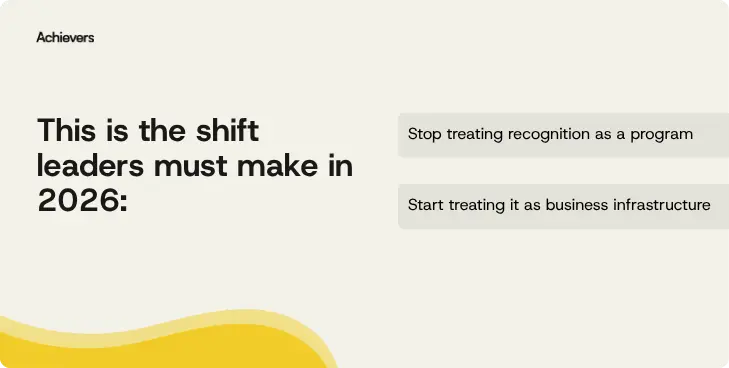
Recognition is infrastructure, not a perk
Here’s where leaders need to rethink their approach entirely. Recognition is often positioned as a cultural “add-on” — something that boosts morale or celebrates success. But the data shows something far more important: It does what communication, training, and strategy alone cannot:- Reinforces priorities in the moment
- Makes expectations visible
- Translates values into action
- Builds confidence under pressure
Recognition as the missing link in AI transformation
Perhaps the most critical insight from the report is that the AI transformation is not a technology problem, it’s a behavior problem. Organizations are asking employees to:- Learn faster
- Adapt workflows
- Use judgment
- Collaborate differently
- Rewarding learning before mastery
- Signaling safe experimentation
- Reinforcing collaboration and judgment
- Embed recognition into daily workflows Not monthly cycles, not campaigns — real-time reinforcement tied to behavior.
- Prioritize frequency over perfection Recognition doesn’t need to be polished, it needs to be timely.
- Make recognition visible across the organization So signals scale, not just individual interactions.
- Balance scale with authenticity Using tools to enable recognition, not replace human judgment.
Recognition gap FAQS
The recognition gap refers to the disconnect between how organizations design recognition and how employees actually experience it. The recognition gap matters in 2026 because employees lack consistent signals that reinforce priorities, build trust, and support performance. Without recognition closing that gap, even strong strategies can stall as employees struggle to translate expectations into action.
Recognition isn’t working effectively in most organizations because it is often delivered too infrequently, too generically, or too far removed from everyday work. When recognition doesn’t happen in real time, it fails to guide behavior or reinforce what matters. As a result, employees may feel uncertain, disconnected, or unsupported despite leadership’s intent to recognize contributions.
Recognition influences performance, connection, and trust by reinforcing the behaviors that drive results and making those behaviors visible across the organization. When employees receive frequent, meaningful recognition, they are more likely to feel connected to their work, understand strategic priorities, and trust leadership. This creates stronger alignment and momentum, especially during periods of change or uncertainty.
Leaders should treat recognition as infrastructure instead of a program because recognition operates inside the flow of work, shaping behavior in real time. When recognition is positioned as a program, it becomes occasional and disconnected. When treated as infrastructure, it continuously reinforces priorities, strengthens alignment, and supports performance, making it a critical system for executing strategy and driving change.
The takeaway for leaders
If you’re skimming for one key takeaway from the 2026 State of Recognition Report, it’s this: Recognition isn’t the reward at the end of transformation. It’s the mechanism that determines whether transformation holds. When recognition is: Frequent → behavior accelerates Meaningful → trust strengthens Visible → alignment scales When it’s not, even the strongest strategies stall. The opportunity for leaders now isn’t to refine recognition programs. It’s to reposition recognition as a core operating system for culture, performance, and change. At Achievers, we arm organizations and their people leaders with the tools and data-driven insights they need to leverage recognition to drive positive change. Talk to us about how we can help.Key insights
- Recognition only drives performance when embedded as real-time reinforcement in everyday work.
- The global recognition gap is a leadership signal that employees lack clear, consistent reinforcement.
- Recognition is the missing link between strategy and behavior, without it, even the strongest transformation efforts stall.


