
Key insights
- Regular check-ins, clear goals, and ongoing conversations drive higher engagement, productivity, and employee retention.
- When recognition is integrated into performance management systems, it reinforces desired behaviors, builds accountability, and improves employee motivation.
- The best systems connect individual performance to organizational priorities while supporting growth through transparency, feedback, and development.
Key elements of effective performance management systems
Let’s be honest: performance management has a bit of a reputation problem. When it’s built around outdated reviews and rigid processes, it rarely reflects how people actually work. But when it’s built around the right components — and practiced consistently — it becomes something better. A system that drives clarity, supports development, and actually helps people do great work. Here’s what that system should include: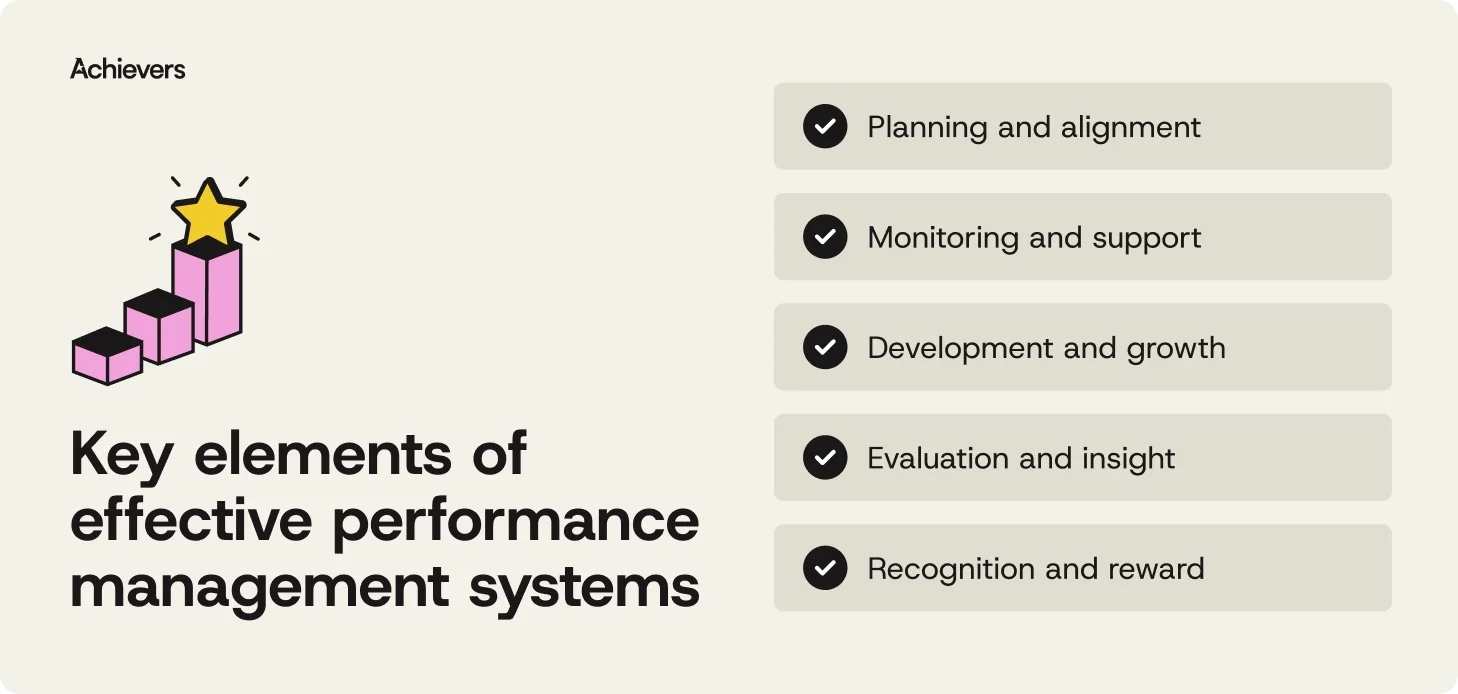
1. Planning and alignment
Every great performance management system starts here — with planning that makes sense. Not just top-down goals that get filed away after kickoff, but real conversations about what success looks like and how each employee’s work fits into the bigger picture. This is where alignment lives. Managers and employees should work together to set clear, measurable, and adaptable goals. That could be through SMART goals, OKRs, or a homegrown framework — the method matters less than the meaning behind it. What’s important is that employees know what’s expected and feel invested in reaching it.2. Monitoring and support
You can’t just set goals and hope for the best. Monitoring is what keeps performance on track — and it’s most effective when it’s ongoing, not reactive. That means check-ins that happen often (and on purpose), real-time feedback that’s actually useful, and the kind of transparency that helps people course-correct before things go sideways. It’s not about hovering. It’s about creating space for employees to share updates, flag roadblocks, and ask for support without fear of judgment.3. Development and growth
Here’s the truth: people want to get better at what they do — but not everyone learns the same way, or at the same pace. That’s why development needs to be personalized, continuous, and rooted in what each employee actually needs to succeed. Whether it’s coaching, training, mentorship, or a stretch project, development should be built into the everyday employee experience — not tacked on when someone’s already struggling. And it shouldn’t only go to your highest performers. When you support growth across the board, you strengthen your talent bench, not just your top 10%.4. Evaluation and insight
Let’s be honest — no one looks forward to performance reviews. But that’s usually because they’re handled badly. When done right, evaluation becomes a chance to reflect on progress, reinforce expectations, and start a more meaningful conversation about what’s next. Good evaluations go beyond just results. They look at how the work was done, the values behind it, and the challenges faced along the way. It’s not about labeling people — it’s about giving context to the story of their performance and showing them you’re paying attention.5. Recognition and reward
When recognition is built into your performance management system, it strengthens accountability, alignment, and results. Recognition reinforces the right behaviors in real time. It builds connection across teams. And it helps employees feel like their effort means something. In fact, Achievers’ State of Recognition Report found that employees who feel recognized are 1.7x more likely to feel their work contributes to a greater purpose. That doesn’t mean every win needs a trophy. A thank-you, a digital high-five, a public shoutout tied to a team goal — these are the moments that build culture. The best recognition platform is easy to use, visible across the company, and tightly integrated with the way performance is tracked and managed. Together, recognition and performance drive stronger results and a better employee experience. And when both are working together, people don’t just perform better. They feel better doing it.The benefits of a strong performance management system
When done right, performance management systems do more than keep tabs on progress. They create clarity, build momentum, and keep your people — and your business — moving in the right direction. Here’s what you can expect when your system’s firing on all cylinders:- Employee engagement and performance clarity: When people know how their work fits into the big picture — and get regular feedback that helps — they don’t just show up. They show up engaged. A solid performance system connects the dots, so employees can see the “why” behind the work, not just the next task on the list.
- Goal-aligned productivity: Clear goals? Check. Real-time feedback? Even better. A good performance system gives people focus — and frees them from back-to-back meetings that go nowhere. The result? More meaningful output, less busywork, and a whole lot less workplace burnout.
- Data-driven performance management: You can’t support your team if you’re working in the dark. The right system gives you visibility — into progress, challenges, and where support is needed most. It’s not about tracking for tracking’s sake. It’s about making better calls on development, resourcing, and growth.
- Business-aligned performance management: When expectations are clear — and tied to real business goals — people stay focused on what matters. Sound performance management systems keep individual efforts moving in sync with company priorities, so everyone’s rowing in the same direction (and no one’s spinning in circles).
Best practices for setting performance management standards
Strong performance management starts with clear standards — the kind that help employees know what’s expected and give managers something solid to coach against. The trick? Balance structure with flexibility. Goals should drive business outcomes, yes — but they should also give people space to grow. Here’s how to get it right:1. Use goal-setting frameworks that work
Skip the guesswork. When it comes to setting performance expectations, clarity wins every time. The best goals are simple, meaningful, and easy to measure — and frameworks can help keep them that way.- SMART goals spell out what success looks like: Specific, Measurable, Achievable, Relevant, and Time-bound. They give employees a clear roadmap — and managers a fair way to track progress.
- OKRs (Objectives and Key Results) are all about outcomes. Start with a big-picture goal, then define 2–5 key results that show you’re getting closer. It’s a great way to stay focused and ambitious, even when priorities shift.
2. Build feedback into the flow of work
Setting goals is just the beginning — it’s regular, 360-degree feedback that keeps performance on track. This doesn’t have to be formal or complicated. When feedback is continuous, conversational, and built into everyday work, it becomes a source of momentum — not anxiety. When managers make space for real conversations, they can:- Offer timely coaching and course-correct early
- Reinforce progress through recognition
- Show employees that their growth is supported, not just evaluated
3. Stay transparent and flexible
Performance standards shouldn’t be a mystery. Employees should know how goals are set, what success looks like, and how they’ll be supported along the way. That level of transparency builds trust. And when priorities inevitably shift? Flexibility matters just as much. Be ready to update goals, reframe expectations, and — most importantly — bring employees into the conversation. Co-creating goals doesn’t just drive alignment. It builds ownership. And that makes performance feel like something employees do with you — not something done to them.Performance management systems FAQs
Performance management systems are the tools and processes that help organizations guide performance — from goal setting and feedback to development and recognition. At their best, they give employees a clear sense of direction, ongoing support, and real opportunities to grow. It’s not just about keeping score — it’s about helping people do their best work and feel good doing it.
There are four main stages in most performance management systems:n
- n t
- Planning: Set clear goals that align with company priorities. n t
- Monitoring: Stay in sync with regular check-ins and feedback. n t
- Evaluating: Reflect on what’s working, where to grow, and how to improve. n t
- Rewarding: Recognize results and reinforce progress. n
A performance management system typically follows a continuous, five-stage cycle designed to support clarity, growth, and results — not just evaluation.n
- n t
- Goal setting: Define clear objectives, expectations, and success measures so employees know what good performance looks like. n t
- Planning and enablement: Align on the strategies, resources, and tools needed to achieve those goals. n t
- Ongoing monitoring and feedback: Use regular check-ins, progress tracking, and real-time feedback to keep performance on course. n t
- Review and adjustment: Discuss outcomes, identify what’s working, and adapt goals or approaches when needed. n t
- Recognition and reward: Acknowledge contributions, reinforce desired behaviors, and connect effort to impact. n
The best performance management system is the one people actually want to use. It’s consistent but flexible, built around clear goals, real conversations, and continuous feedback — not just once-a-year reviews. It supports growth, reinforces recognition, and helps people see how their work connects to the bigger picture.
Performance management typically shows up in three key ways: strategic, administrative, and developmental — each serving a different purpose in how organizations guide performance.n
- n t
- Strategic performance management connects individual goals to business priorities, so people know their work actually moves the business forward. n t
- Administrative performance management handles the structure — reviews, documentation, compliance, and pay decisions — the necessary groundwork that keeps things fair and consistent. n t
- Developmental performance management focuses on growth, using coaching, feedback, and learning to help employees keep getting better. n


