
Key insights
- External appreciation from customers, patients, and guests reinforces employee purpose and engagement.
- Frontline employees often feel unseen, and external recognition makes their impact visible and valued where it matters most.
- External recognition drives pride, loyalty, and performance — and with Achievers, it’s simple to capture, share, and scale.

The challenge: Frontline employees are undervalued
Frontline employees shape how customers, patients, and guests experience your brand — yet too often, their impact goes unnoticed. Despite being the face of organizations, many feel overlooked, disconnected, and undervalued. Achievers Workforce Institute (AWI) data makes this clear:- 40% of healthcare workers say they’re never meaningfully recognized
- 37% of retail employees feel overlooked
- 54% of hospitality staff feel underappreciated.
- Among the 2.7 billion frontline workers worldwide, nearly 3 in 10 say they’re never recognized at work
- Fewer than 30% feel engaged
- Only 25% of offline workers feel included
The opportunity: External recognition makes it personal
External recognition captures real, unsolicited praise from the people your employees impact most. It brings visibility to everyday excellence, adds emotional weight to recognition, and builds a stronger sense of belonging for customer-facing teams. Here are some examples of this in action from various industries: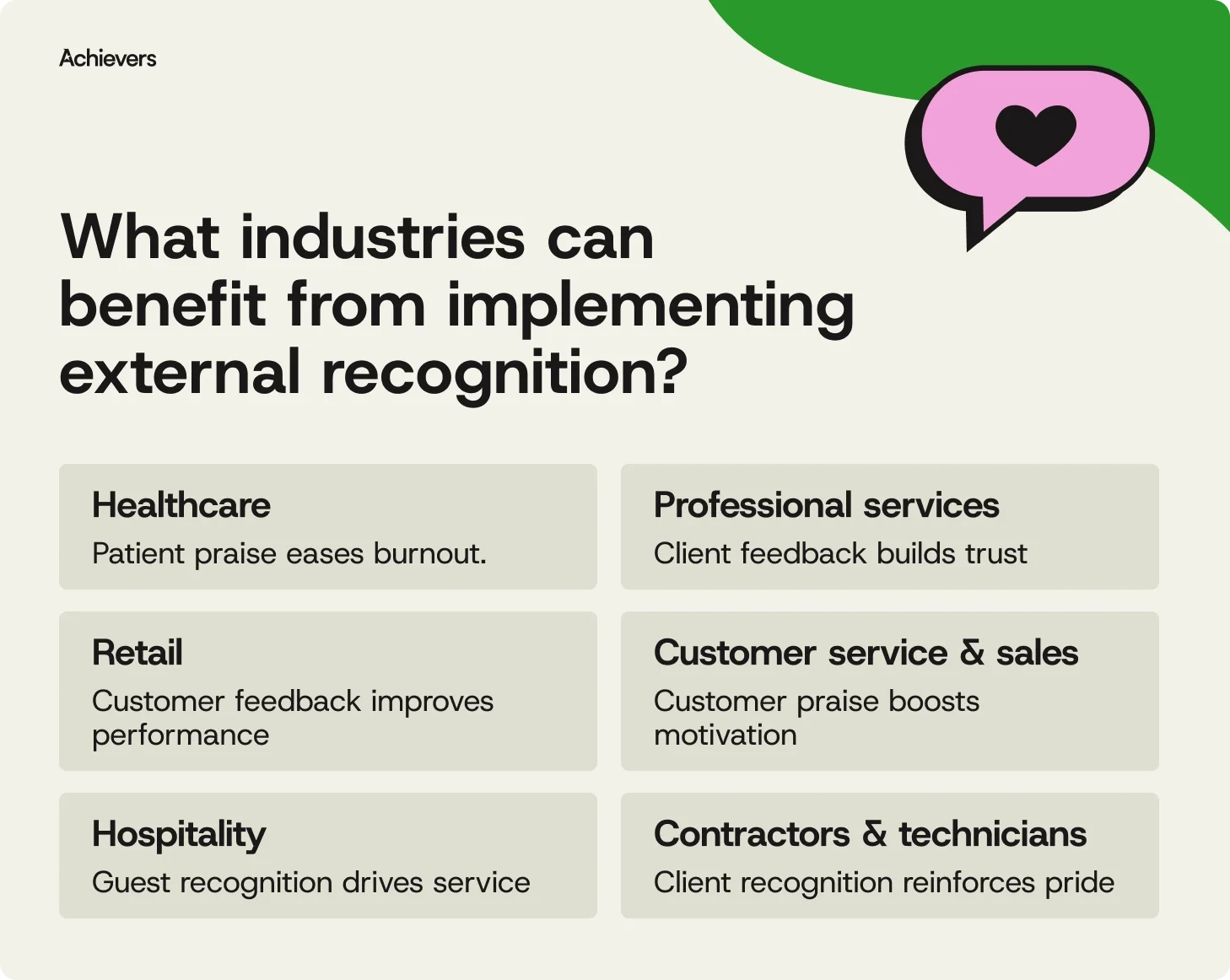
Healthcare
Healthcare workers often carry heavy emotional and physical loads, and recognition can make the difference between burnout and resilience.- Pain point: Burnout and retention challenges are widespread, with many healthcare employees feeling unseen despite the critical role they play in patient care.
- Opportunity: Patient recognition sustains purpose and morale. At Seattle Children’s Hospital, patient-submitted recognitions led to a 10% engagement lift, showing how gratitude directly supports resilience.
Retail
In a fast-moving, high-turnover environment, retail employees rarely get timely feedback that shows their impact.- Pain point: Constant turnover and limited customer feedback leave employees feeling disconnected from their contributions.
- Opportunity: QR code recognition makes it easy for shoppers to highlight standout service on the spot, boosting morale and building a culture of customer-focused excellence.
Hospitality
From front desk to housekeeping, recognition can be inconsistent — even though service quality depends on every role.-
- Pain point: Recognition often varies by role and location, leaving essential staff like cleaners and servers undervalued.
Professional services
For many client-facing roles, recognition happens quietly — or not at all — leaving valuable contributions invisible.- Pain point: Recognition in professional services often lacks visibility, making it difficult to validate effort in roles that depend heavily on client relationships.
- Opportunity: External recognition turns client feedback into a strategic advantage, reinforcing performance, strengthening trust, and shining a light on work that might otherwise go unnoticed.
Customer service & sales
In high-pressure environments where performance is tied directly to customer outcomes, recognition often only shows up when something goes wrong.- Pain point: Customer service and sales employees frequently face rejection, long hours, and demanding performance targets. Without positive reinforcement, their resilience and motivation can erode quickly.
- Opportunity: External recognition from customers validates effort, celebrates wins, and provides the emotional lift needed to keep teams engaged. For example, customer-submitted praise can highlight moments of exceptional service, turning everyday interactions into stories of success that fuel motivation and strengthen team culture.
Contractors & technicians
Field-based employees often work independently, with contributions that go unseen unless there’s a problem.- Pain point: Contractors and technicians regularly face isolation, unpredictable schedules, and limited visibility into how their work impacts the customer. Recognition is often delayed, inconsistent, or completely overlooked.
- Opportunity: Real-time feedback from customers gives these employees the visibility and validation they deserve. When clients or homeowners share recognition directly after a service call or installation, it reinforces pride, builds trust, and strengthens loyalty to both the employer and the brand they represent.
The takeaway? External recognition shines a light on authentic gratitude — making it timely, meaningful, and personal.
The solution: How Achievers’ external recognition offering can help your business
The most meaningful “thank you” often comes from the people employees serve every day. Achievers’ external recognition offering makes those moments easy to capture, simple to share, and powerful enough to fuel both culture and business outcomes. Here’s how:Extend recognition beyond company walls
- Patients, customers, and clients can directly recognize frontline employees, ensuring the people who make the biggest daily impact are seen and celebrated.
- This approach captures authentic, unsolicited praise that reinforces employee purpose while building stronger emotional connections with the organization.
Make recognition simple and accessible
- Easy-to-use QR codes and links ensure recognition happens in the moment, eliminating barriers like app downloads or complicated forms.
- Branded, customizable recognition forms align with your organization’s values and programs — for example, DAISY Awards in healthcare — to make every recognition meaningful and consistent.
Deliver meaningful impact for employees
- Notifications and points make each recognition visible and rewarding, ensuring employees feel the appreciation in real time.
- Because external recognition comes from the very people employees serve, it carries unique weight that boosts morale, strengthens retention, and drives deeper engagement.
Empower admins with control and insights
- Smart approval workflows filter each recognition for quality and compliance, keeping submissions respectful, relevant, and on brand.
- AI-powered employee matching guarantees that the right person is celebrated every time, removing the risk of recognition getting lost in translation.
- Built-in insights highlight standout performers and uncover scalable best practices, helping leaders replicate excellence across the organization.
Drive business outcomes through stronger relationships
- In healthcare, external recognition reduces burnout and improves patient satisfaction by reinforcing the purpose behind care.
- In retail, it combats turnover while elevating service excellence by making recognition part of the customer experience.
- In hospitality, it motivates staff and sustains five-star service standards through timely guest feedback.
- In professional services, it strengthens client trust and validates performance by making client appreciation visible and actionable.
Prove measurable results
- Early pilots have shown significant engagement lifts, with external recognition sparking additional peer-to-peer recognition across teams.
- Over time, this creates a “pay it forward” culture, where one recognition inspires another and positivity spreads throughout the organization.
External recognition FAQs
External recognition is appreciation that comes directly from the people employees serve — like customers, patients, or guests. It captures authentic feedback in the moment, turning everyday gratitude into meaningful recognition.
External recognition happens when appreciation comes from outside your organization — like customers, clients, or industry groups. It might be a patient thanking a nurse, a client praising great service, or your company earning an award. Unlike internal recognition, which comes from peers or leaders, external recognition shows that your work really matters to the people you serve.
External recognition is simple and seamless. Customers, patients, or partners can use easy tools — like QR codes or any link — to share appreciation instantly. That recognition flows into the company’s recognition newsfeed, where employees are notified, celebrated, and often rewarded. The process makes gratitude visible, personal, and actionable, reinforcing the behaviors that drive great service and stronger relationships.
External recognition is built for frontline and customer-facing employees who interact directly with the people your business serves. From healthcare professionals to retail associates to hospitality staff, these employees thrive when their contributions are acknowledged. It also benefits organizations, because recognition from the outside boosts morale, retention, and customer satisfaction — making it a win-win for employees and employers alike.
Implementing external recognition turns gratitude into a powerful business tool. When employees hear “thank you” directly from customers or patients, it fuels engagement, reinforces purpose, and reduces turnover. For organizations, it means better service, stronger loyalty, and a culture where recognition flows in every direction. In other words, external recognition isn’t just nice to have — it’s a strategy that pays off.
There are two main types of recognition: monetary and non-monetary.nnMonetary recognition includes financial rewards — like bonuses, gift cards, or points that can be redeemed for meaningful rewards. These gestures show tangible appreciation and can be especially motivating when tied to clear achievements or milestones.nnNon-monetary recognition focuses on the emotional and social side of appreciation — a public thank-you, peer-to-peer shout-out, or a note from a leader that spotlights effort and impact. It reinforces belonging and connection in ways money alone can’t.nnThe most effective recognition strategies use both blend the two — from global rewards and concierge-style experiences to everyday recognition moments, social feeds, and real-time feedback tools.
Extrinsic rewards are the external motivators that make great work feel seen and valued. They can include financial rewards like bonuses, raises, or profit-sharing, as well as career-based perks such as promotions or public shout-outs. Many companies also offer benefits and experiences — from extra vacation days and flexible schedules to gift cards or travel opportunities.
The takeaway: gratitude isn’t limited to your org chart
Recognition from external voices isn’t just a nice-to-have — it’s a business strategy with staying power. When customers, patients, and clients are invited to share appreciation, beyond those yearly healthcare recognition days, employees feel seen in ways that internal programs alone can’t always deliver. The result is lower attrition, higher engagement, and a ripple effect of positive behaviors that strengthen both culture and customer experience. With Achievers, organizations can make this strategy simple, scalable, and impactful. Our external recognition offering extends appreciation beyond company walls, empowering employees to connect with purpose and organizations to unlock measurable results. After all, gratitude may not show up in your org chart, but it can absolutely show up in your bottom line. And that’s a result worth recognizing.


