
Key insights
- Incentive programs only influence performance when employees clearly understand which actions are expected and recognized by leaders.
- Programs built around occasional rewards fail because they lack consistency and visibility across the business.
- The most successful incentive programs include recognition and rewards as a way to highlight when great work is done and set a clear standard for what to repeat.

What are employee incentive programs?
Employee incentive programs are structured ways organizations motivate and recognize employees for meaningful contributions. These programs use rewards like recognition, bonuses, points, development opportunities, and time off to reinforce behaviors that drive results. When employee incentive programs are designed well, they help employees feel seen, heard, and appreciated — leading to higher engagement, stronger performance, and better retention over time. These programs use meaningful rewards to spark the behaviors you want more of, like collaboration, project ownership, innovation, and all-around great work.Why do employee incentive programs matter?
Employee incentive programs matter because they act as a structured way to reward great work, through bonuses, points, recognition, development opportunities, wellness perks, lifestyle benefits, and more. The most effective programs do more than hand out rewards. They also shape behavior. But here’s the difference between programs that work and those that don’t:Effective incentives create appreciation, and appreciation changes everything
- 12× more likely to find their work meaningful
- 17× more likely to feel connected to colleagues
- 17× more likely to see a long‑term career at their company
- 56× more likely to feel connected to company values
Who is impacted the most by employee incentive programs?
Employees are impacted most by incentive programs when they need more opportunities to be recognized, develop new skills, connect with their work, or see a future with the organization. Incentive programs have the greatest effect on employees who lack consistent recognition, clear career growth opportunities, or a strong sense of belonging. Recognition-based incentives help employees understand which contributions matter. Growth-focused incentives help employees build skills and advance their careers. Connection-focused incentives, such as social recognition and employee resource groups, strengthen relationships with colleagues and improve office culture.Where do employee incentive programs have the biggest impact?
Employee incentive programs have the biggest impact across employee performance, career development, well-being, and retention. Organizations use incentive programs to reinforce the kind of behaviors that help employees achieve performance goals and continue to invest in their growth and internal mobility. They also create a culture of belonging that encourages employees to refer qualified candidates and build long-term careers within the organization.When do employee incentive programs work and fail?
Employee incentive programs work when they reinforce behaviors employees can control and are reinforced with frequent manager-led recognition. They fail when they’re inconsistent, impersonal, or treated as a one-time reward. Programs that reinforce collaboration, innovation, customer service, growth, or company values are more likely to result in long-term engagement. The same programs are less effective when employees view rewards as automatic, unfair, or unrelated to their efforts or performance.How do employee incentive programs work in practice?
Employee incentive programs work in practice by offering incentives to employees for actions such as achieving performance goals, demonstrating company values, participating in recognition programs, referring candidates, completing training, or reaching career milestones. The incentive is tied to a specific action or outcome. When employees complete that action, they receive recognition, rewards, development opportunities, time off, bonuses, or other benefits. This creates a clear connection between contribution and appreciation, and reinforces those behaviors or actions as ones that are valued by their managers and the organization.25 employee incentive programs to improve engagement
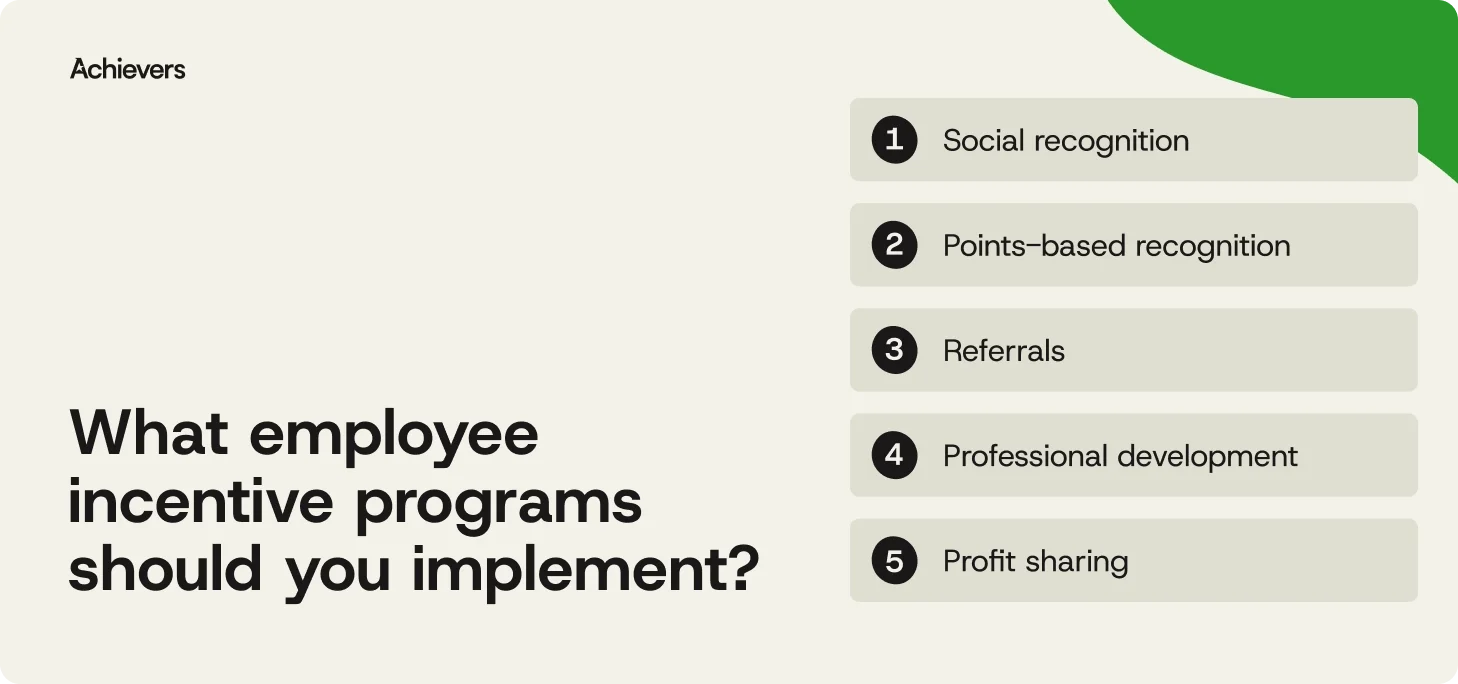
1. Social recognition programs
Social recognition shines a spotlight on everyday wins — and it works. It makes effort visible, and visibility drives connection. Employees who feel appreciated are 41× more likely to feel connected to their manager and 47× more likely to feel supported in their well‑being. And as a bonus to the business, they’re also 55% less likely to leave.2. Points-based recognition programs
Points‑based rewards reinforce contribution with choice and meaning. Employees earn rewards based on their performance, and they can spend those points however they like from a reward marketplace. It’s a great way to keep morale high and performance even higher. AWI data confirms it, with 85% of employees saying they’re likely to repeat an action when they’re recognized for it — making rewards one of the most effective behavior‑shaping tools available.3. Referral programs
Referral programs make employees your best recruiters by tapping into the power of connection — one of the strongest engagement drivers. Employees with strong peer connections are 3× more likely to see a long career at their company. And with tiered rewards and integration into your recognition program, you’ll not only fill your pipeline with top talent, but also keep your team excited about bringing in the best.4. Professional development programs
Professional development programs reward employees with opportunities to build new skills, advance their careers, and prepare for future roles. The result? More productivity and loyalty. According to external research collected by Devlin Peck, , companies that offer training to engaged employees see 17% higher productivity and 21% more profitability. It’s also a retention strategy. Research from Achievers’ Engagement and Retention Report, collected from 3,000 employees globally, shows that only 22% of employees say they have access to growth opportunities, but those who do are:- 2× more likely to see a long‑term career
- 2.5× more engaged when developing skills
- 2.5× less likely to be job hunting
5. Profit-sharing programs
Profit sharing is like saying, “You helped make this happen.” Employees who share in the company’s success become more engaged and loyal. And if profit sharing isn’t on the table, 401(k) matches work just as well. Either way, it’s a gesture that keeps employees motivated and invested in the company’s future.6. Health and wellness programs
Wellness programs are an important tool to help prevent burnout and keep your team feeling their best. Employees who feel supported in their well‑being will feel appreciated and far less likely to be looking for work.7. Tuition reimbursement programs
Tuition reimbursement programs are a great way to invest in the future. Tuition reimbursement not only boosts retention but also ensures employees feel more prepared for their work. 84% of employees feel more prepared for their roles after getting education support, so it’s a benefit that pays off big time.8. Bonuses and raises
Bonuses and raises are a clear and direct way to show appreciation. 52% of workers say they feel more valued when they get an annual bonus. Make sure the goals are clear and attainable, and you’ll have employees motivated and striving for excellence (without the rivalry).9. Fun gifts
Fun gifts show employees they’re appreciated, whether it’s a shiny gadget or an experience. Make them personal or give employees the power to choose what matters most to them, whether that’s a gift card or a piece of company swag. It’s a small gesture that makes a big impact on morale.10. Additional time off
Additional paid time off as a reward for hitting goals not only boosts satisfaction but also keeps burnout at bay.11. Choice of projects
Project choice is a great way to keep employees motivated, engaged, and showing off their best work. By letting them pick projects that match their passions or strengths, organizations can increase ownership while encouraging them to stay invested in their work and continue to develop new skills.12. Employee benefits program
An employee benefits program shows employees you care about their health and happiness. Comprehensive benefits like health insurance, paid time off, and more keep employees feeling secure and engaged, building loyalty while attracting top talent.13. Human resources development
HR development is all about long-term growth. Companies that focus on enhancing employees’ skills see a huge increase in engagement and satisfaction. Investing in talent development shows your team that you’re committed to their growth, and that’s a big motivator for top performers.14. Performance management programs
Performance management programs should help employees connect their work to growth and impact. Today, that link is weak. Only 22% of employees feel they have the tools and growth opportunities needed to perform at their best, and just 18% have regular 1:1s with their manager. That gap matters, because consistent feedback, coaching, and recognition are strongly tied to higher engagement and retention. Performance management needs to move beyond annual reviews and become a continuous, recognition‑led experience that helps people grow and do their best work.15. Travel incentives
Travel incentives turn achievement into adventure, offering fully paid trips for hitting targets. Through the Achievers Travel Store, powered by Switchfly, employees can choose from 1.6M+ global options — spanning hotels, flights, car rentals, and activities. That’s why it’s no surprise that 53% of senior leaders call travel a “must-have” and 48% see it as a strategic differentiator for boosting morale, performance, and loyalty.16. Commission programs
Commission programs directly link effort to reward. They’re a great way to motivate sales teams and align their success with the company’s growth. It’s a system that pays off, with $200 billion spent on sales compensation in the U.S. every year.17. Flextime programs
Flextime programs are a powerful tool for retention, with insights from Forbes showing 80% of employees saying they’d stick around longer with flexible hours. Allowing employees to set their schedules shows trust and helps them balance their personal and professional lives, which boosts engagement and keeps morale high.18. Employee resource groups (ERGs)
ERGs help build belonging and connection, two of the strongest predictors of retention. According to the Achievers Workforce Institute’s 2026 Engagement and Retention Report, employees who feel a strong sense of belonging are 2.2x more likely to see a long‑term career at their company and 2x less likely to be job hunting. By creating spaces where employees feel heard, supported, and connected to peers, ERGs strengthen engagement, collaboration, and loyalty, while signaling to current and future talent that their voices genuinely matter.19. Customized learning stipends
Customized learning stipends let employees invest in their own growth. Offering funds for courses or conferences shows you care about their personal development. It’s a great way to motivate employees to keep learning, and it’s a win for both their career and your business.20. Sabbatical leave rewards
Sabbatical leave rewards allow employees to recharge, come back fresh, and tackle new challenges with renewed energy. It’s a great way to reward loyalty, prevent burnout, and keep top talent happy and engaged. Sometimes, a little time off is just what an employee needs to bring their best self to work.21. Green commuting incentives
Green commuting initiatives, like biking or public transit, not only helps the planet but also shows employees you care about their well-being. These incentives are a great way to promote sustainability, reduce commuting costs, and improve health, all while aligning with your company’s values.22. Wellness challenges with rewards
Wellness challenges with included rewards turn healthy habits into fun competitions. Whether it’s step goals, fitness milestones, or nutrition challenges, rewards keep employees engaged in their well-being. It’s a fun way to foster team spirit while encouraging everyone to stay healthy and motivated.23. Family-oriented perks
Family-oriented perks, like scholarships or allowances for family outings, show employees you care about their personal lives. Supporting family life increases work satisfaction and performance, making your company more attractive to top talent and increasing employee loyalty.24. Recognition through peer awards
Recognition through peer awards fosters collaboration and appreciation, empowering employees to recognize each other’s contributions. This creates a positive, inclusive work environment where recognition is shared at all levels, boosting morale and motivating employees to go above and beyond.25. Innovation incentives
Innovation incentives reward creative ideas that improve business outcomes. Recognizing and implementing these ideas with bonuses or leadership opportunities encourages a culture of creativity, helping employees feel empowered to drive change and continuous improvement within the company.What are the best practices for employee incentive programs?
These best practices help make incentive programs more effective and consistent across the entire organization: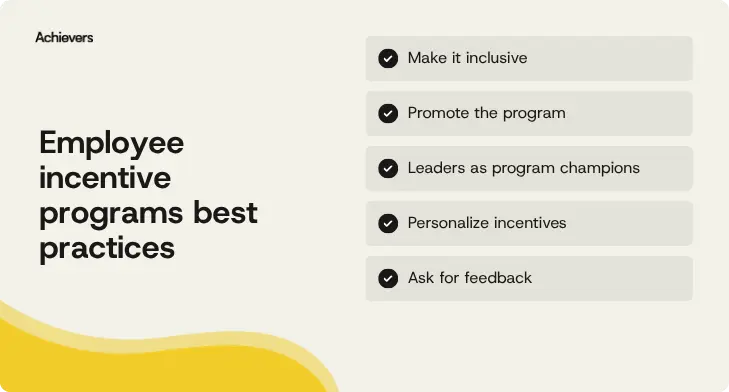
Make your program inclusive
Incentive programs drive participation when employees can access them during their normal workday, using the tools and systems they already rely on. Digital tools, frontline teams, and hybrid employees all need a clear way to participate. Recognition, specifically, should apply to managers, peers, and contributors across all roles. When access is limited to only a few groups, participation drops and the program loses visibility.Promote your incentive programs
Incentive programs fail when employees don’t know what actions are recognized or how to participate. Communication should show exactly what behaviors earn incentives and where recognition happens. Reinforce those patterns consistently so employees see real examples of what gets recognized and repeated.Train leaders to become program experts
Incentive programs depend on consistent leadership behavior in order to be successful. Managers control when recognition happens and what gets reinforced. Training should focus on recognizing specific actions tied to goals, delivering recognition in real time, and using incentives to reinforce repeated performance. When managers don’t model this, adoption stalls.Personalize your incentives
Incentives lose impact when they feel generic. Different roles, locations, and career stages respond to different types of rewards. Use employee input to shape options that reflect those differences. When incentives match what employees value, participation becomes more consistent.Ask for feedback
Incentive programs rely on clear signals from employees about what is and isn’t working. Use surveys, participation data, and direct input from employee feedback tools to identify gaps in recognition and low adoption areas. Apply those insights to adjust the types of incentives offered, so they stay connected to real employee behavior.How do you implement an incentive program in your organization?
1. Define what success looks like before you launch
Start with a clear definition of what your incentive program is meant to change in the organization. Identify the specific behaviors tied to business priorities and decide how they’ll be recognized. Without that clarity, incentives become disconnected from outcomes and difficult to measure.2. Design recognition as the foundation
Build the program around recognition first, then add incentives as an additional layer. Recognition explains why a behavior matters and makes it visible to others. Incentives reinforce that behavior after it’s been recognized. When recognition is missing, incentives lose context and feel transactional.3. Launch with clear participation rules
Explain how employees can participate, what actions will be recognized, and how incentives are earned. Participation shouldn’t rely on interpretation or manager discretion. Clear rules create consistency and make it easier to scale the program.4. Measure behavior and adjust early
Track where recognition is happening, which behaviors are being reinforced, and where participation is low. Use that data to refine the program before gaps become patterns. Programs that aren’t adjusted early tend to lose alignment with how work actually happens.What are the benefits of employee rewards programs?
Employee rewards programs help organizations reinforce the behaviors that drive performance while strengthening engagement and connection across the workforce. Key benefits include:- Higher engagement and motivation: Meaningful rewards encourage employees to stay involved and contribute at a higher level
- Improved retention: Recognizing and rewarding contributions helps employees feel valued, reducing the likelihood of turnover
- Stronger alignment to company goals: Rewards tied to values and objectives reinforce the behaviors that matter most
- Increased participation in recognition: Adding rewards can boost visibility and encourage more consistent recognition across teams
- Better overall performance outcomes: When employees feel appreciated, they are more likely to repeat high-impact behaviors that support business results
How do you improve employee engagement with rewards?
To improve employee engagement with rewards, focus on three key actions:- Reward behaviors you want repeated: Tie rewards to specific actions such as collaboration, innovation, customer service, safety, or living company values. Employees are more likely to repeat behaviors that are consistently recognized.
- Make recognition frequent: According to Achievers Workforce Institute’s 2026 State of Recognition Report, research from 3,000 employees surveyed found that those who receive frequent, meaningful recognition are 2.6x more likely to be productive and 6x more likely to stay with their employer. Rewards give managers and peers a consistent way to recognize contributions as they happen, making recognition more visible and easier to repeat.
- Offer reward flexibility: When rewards reflect individual preferences, whether that’s the flexibility of gift cards or customizable travel experiences, employees are more likely to view them as valuable and relevant.
- 12x more likely to find their work meaningful
- 17x more likely to see a long-term career at their company.
- 2.6x more likely to be productive
- 6x more likely to stay with their company long-term.
How can I find an employee incentive program that allows for seamless integration with our current software?
To find an incentive program that can integrate with your current software: Look for plug‑and‑play integrations: Choose platforms that already connect with tools your team uses every day (e.g., HRIS, collaboration, and productivity tools), so setup is faster and adoption is easier.- Check for open API capabilities: Open APIs allow the platform to connect with custom or less common systems, providing flexibility as technology needs evolve.
- Request integration details through an RFP: Ask vendors to outline their integration capabilities through an RFP form, along with security, compliance, and pricing, so you can compare platforms on more than just features.
- Prioritize enterprise‑grade integrations: For example, Achievers offers certified integrations with platforms like Workday, Zoom, LinkedIn, Salesforce, and Microsoft tools, helping recognition fit into existing workflows.
- Evaluate how recognition fits into daily work: The goal is to avoid requiring a separate login or system. Programs that work inside existing tools make participation faster and easier.
- Assess impact on usage and engagement: Programs that integrate well see higher adoption and more consistent participation, because employees can recognize and reward in real time without interrupting their workflow, which leads to stronger engagement across the workforce.
How do employee incentive programs improve performance?
Employee incentive programs improve performance by clearly linking effort to recognition and reward. When employees see that their contributions are noticed and valued, they’re more likely to repeat high‑impact behaviors. Programs that combine recognition, feedback, and meaningful rewards help employees understand what success looks like, stay motivated, and continuously grow, which leads to stronger individual and business performance. Employee incentive programs improve performance by:- Reinforcing the right behaviors through timely recognition that shows employees exactly what success looks like
- Increasing motivation and effort by making the connection between contribution and reward visible and consistent
- Building confidence and momentum as employees receive regular feedback and positive reinforcement
- Strengthening accountability and alignment by tying recognition to values, goals, and measurable outcomes
- Encouraging continuous growth by recognizing progress, not just results, which drives sustained performance over time
What are the right KPIs to measure the success of your employee incentive program?
To understand whether your employee incentive program is driving real impact, you need KPIs that connect recognition to engagement, retention, and performance. The right metrics reveal what’s working, where to improve, and how recognition supports business outcomes.Participation rates
Participation shows reach. Tracking how many employees are actively taking part helps you understand whether your program is inclusive, accessible, and embedded across the organization, and not just used by a select few.Recognition frequency
How often recognition happens matters. Recognition frequency signals whether appreciation is becoming part of everyday work or remaining occasional and inconsistent. More frequent, timely recognition is a strong indicator of a healthy recognition culture.Employee engagement scores
Regular engagement surveys help you track shifts in morale, motivation, and connection over time. When incentive programs are working, improvements in engagement scores tend to follow, especially in areas tied to feeling valued and appreciated.Retention and voluntary turnover
Retention is one of the clearest indicators of program success. Effective incentive programs should contribute to higher retention and lower voluntary turnover, particularly among high performers and critical roles.Performance metrics
Look at business outcomes such as goal attainment, sales growth, project completion rates, or customer satisfaction. When incentives reinforce the right behaviours, performance metrics move with them.Employee feedback
Qualitative feedback adds essential context. Pulse surveys, open‑text responses, and focus groups help you understand how employees experience the program and whether it aligns with what motivates individuals and teams.Reward redemption rates
Redemption rates reveal perceived value. If rewards go unused, it may signal a mismatch between incentives offered and what employees actually want. To deepen insight, consider layering in metrics like productivity gains, reduced absenteeism, and internal mobility or promotion rates. Together, these indicators help connect recognition to long‑term workforce outcomes. Regular reporting and benchmarking ensure your employee incentive program doesn’t just perform today — but continues to evolve and deliver results over time.Employee incentive programs FAQs
Employee incentive programs are important for engagement and retention because appreciation directly influences how employees feel about their work and future at an organization. Research from the Achievers Workforce Institute shows that employees who feel appreciated are far more likely to feel engaged, connected, and committed long term. Effective employee incentive programs turn recognition into a daily habit and not an annual event.
There are two types of incentives: monetary and non-monetary incentives. Monetary incentives like bonuses and profit sharing offer direct financial rewards tied to performance, making them powerful motivators for short-term results.nnNon-monetary incentives, such as recognition, flexible work, and growth opportunities, encourage intrinsic motivation, build connection, and reinforce company values.nnCombining both strategies addresses a wider range of employee needs, deepening engagement, loyalty, and retention. A balanced approach shows employees they are valued for more than just their output, fueling long-term commitment and a thriving culture.
Smaller companies can compete with large businesses by focusing on reward impact, not scale, using a range of recognition and reward options:nu003culu003en tu003cliu003eu003cstrongu003eGrowth and development:u003c/strongu003e Recognize learning milestones, certifications, and skill-building to reinforce progress and long-term career value.u003c/liu003en tu003cliu003eu003cstrongu003ePeer-to-peer and manager recognition:u003c/strongu003e Frequent, visible recognition tied to values builds engagement and belonging at a fraction of big-company costs.u003c/liu003en tu003cliu003eu003cstrongu003eWellness support:u003c/strongu003e Wellness stipends and lifestyle spending let employees choose what supports their well-being, physically, mentally, or financially.u003c/liu003en tu003cliu003eu003cstrongu003eFlexible work:u003c/strongu003e Recognition focused on outcomes, not output, makes hybrid and flexible work a competitive advantage.u003c/liu003en tu003cliu003eu003cstrongu003eMilestone celebrations:u003c/strongu003e Automating birthdays, service anniversaries, and career moments helps employees feel seen and stay longer.u003c/liu003enu003c/ulu003enUsing recognition as the foundation makes benefits more meaningful, memorable, and aligned to what employees truly value.
Achievers is an example of an u003ca href=u0022https://www.achievers.com/blog/examples-impactful-employee-recognition-programs/u0022u003eimpactful recognition programu003c/au003e because it combines social recognition, points‑based rewards, global reward redemption, and employee feedback tools in one platform.nnIt’s impactful because it solves the core problem most recognition programs have: they’re inconsistent and hard to scale. With Achievers, recognition can happen between peers or managers at any time, rewards are available to employees globally (not just in one region), and their u003ca href=u0022https://www.achievers.com/blog/employee-survey-tools/u0022u003esurvey toolsu003c/au003e show whether employees are engaging with the program, how they’re engaging, and overall sentiments. With that data, leaders can see gaps in participation, identify which teams or locations are underrepresented, and adjust the program so recognition is used consistently across the entire workforce.
u003ca href=u0022https://www.achievers.com/solutions/mid-market-business/u0022u003eMid-sized and growing organizationsu003c/au003e don’t need to match big-company benefits to compete, but they do need to use rewards in a way that delivers clear, immediate value without adding complexity. Employee rewards are most effective when they’re both flexible and easy to manage and scale, and directly tied to the actions and behaviors that matter most to the business. Over time, employees see a clear link between what they do and how it is valued. That clarity builds consistency and keeps employees engaged, even without large, complex benefits programs.
Employee rewards impact profit by improving productivity, reducing turnover costs, and lowering the cost of hiring.nu003culu003en tu003cliu003eu003cstrongu003eThey improve productivity by reinforcing the right behaviors:u003c/strongu003e Rewards show employees what actions matter and encourage them to repeat them. Over time, this creates consistency in how work gets done, reduces wasted effort, and increases overall output.u003c/liu003en tu003cliu003eu003cstrongu003eThey reduce turnover and the costs that come with it:u003c/strongu003e Replacing employees is expensive and slows down teams. Rewards help prevent this by making employees feel valued and connected to their work. Research from the u003ca href=u0022https://www.achievers.com/resources/engagement-retention-report/u0022u003e2026 Engagement and Retention Reportu003c/au003e, which surveyed 2,500 employees across eight regions, found that 75% of employees say not being appreciated with rewards would impact their decision to stay at the company. Higher turnover leads to greater hiring costs, longer ramp times for new employees, and lost productivity across teams.u003c/liu003en tu003cliu003eu003cstrongu003eThey lower hiring and replacement costs:u003c/strongu003e When more employees stay, companies spend less on recruiting, onboarding, and training. A strong u003ca href=u0022https://www.achievers.com/blog/employee-rewards-programs/u0022u003erewards programu003c/au003e also makes it easier to attract talent by reducing reliance on compensation alone, along with both the time and cost required to fill roles.u003c/liu003enu003c/ulu003e
Incentives and recognition work together in Achievers
Achievers brings incentive programs into one platform so they can be managed as a single, consistent system. Recognition, rewards, feedback, and performance data are all connected, allowing every action to be recognized, tied to a goal or value, and reinforced with an incentive, all within the same software. With Achievers, HR and people leaders have a direct view of who’s participating, what actions are being recognized, and where programs aren’t reaching teams. With that visibility and control, incentives become easier to run and easier to scale.


