
6 strategies to support employee development
Supporting employee development isn’t about handing out course links and hoping for the best. It’s about creating real opportunities for growth — the kind that feel personal, practical, and connected to how people actually work. These are the strategies that offer a flexible, people-first approach to development: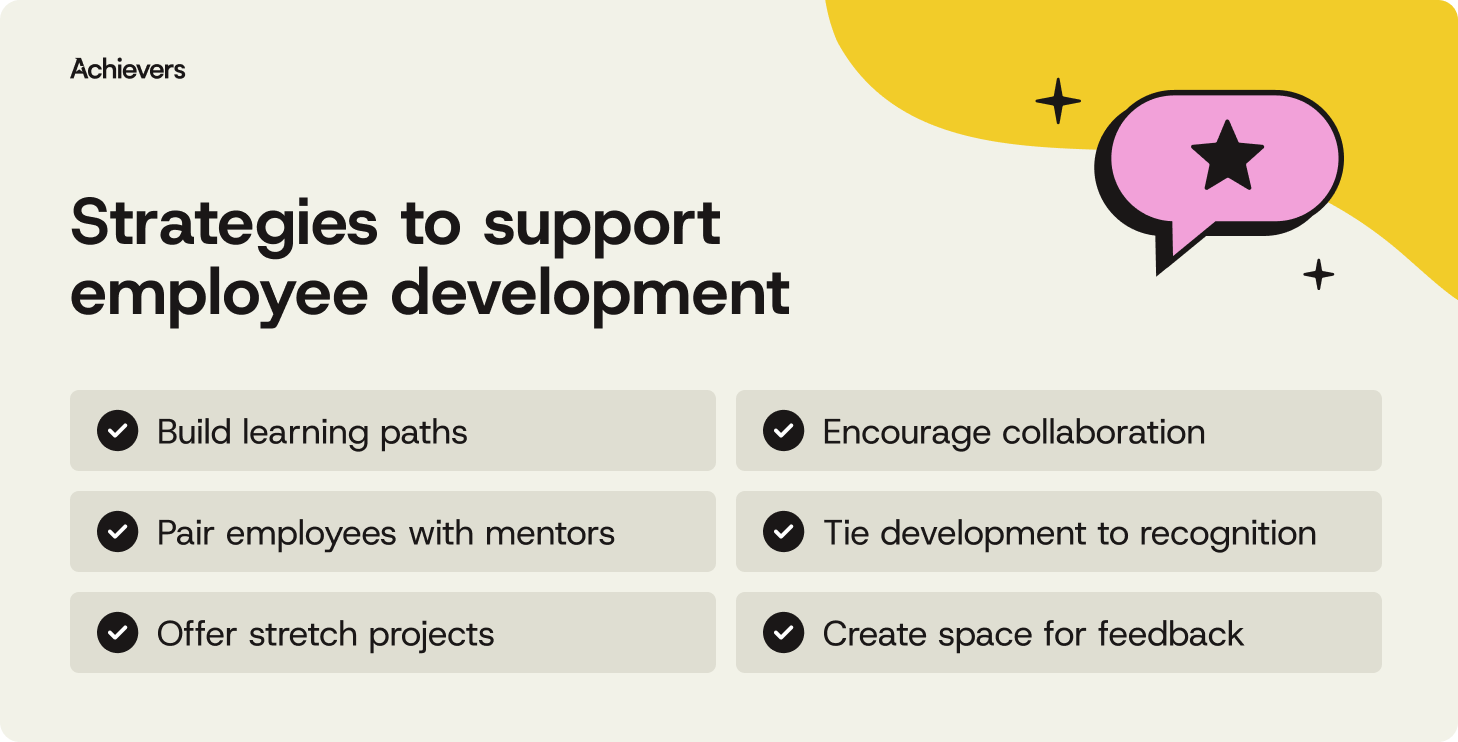
1. Build personalized learning paths
Nobody’s excited about a one-size-fits-all training program. Real growth happens when learning feels relevant — and when employees actually have a say in what that growth looks like. Here’s how to build learning paths that stick:- Set development goals together: Help employees shape their own professional growth plans with their managers, so it’s a shared effort — not a top-down assignment.
- Offer role-specific learning: Use an LMS or personalized course libraries to deliver content that actually fits the job, not just the checkbox.
- Make it flexible: Think self-paced, on-demand, and mobile-friendly — learning that fits into how (and when) people work.
- Mix up the format: Microlearning, videos, certifications, hands-on projects — different people learn in different ways.
- Check in often: A good learning path evolves. Make space to revisit goals, track progress, and adjust as roles shift.
2. Pair employees with mentors or coaches
Growth doesn’t show up out of nowhere. It starts with a conversation. That’s why mentorship is one of the most powerful (and underrated) ways to support employee and talent development. Here’s how to build meaningful mentoring experiences:- Encourage cross-level or peer mentorship: Great ideas don’t just flow top-down — peer mentoring helps employees learn from different perspectives and build real connections.
- Frame mentorship as a two-way street: Mentors grow too. Sharing knowledge, offering feedback, and listening builds democratic leadership skills and strengthens culture.
- Make it part of everyday work: Not every moment has to be formal. Encourage managers to find small coaching opportunities in regular 1:1s, project reviews, or quick Slack chats.
- Support with structure, not scripts: Offer conversation guides or discussion prompts — just enough to get the ball rolling without over-engineering the relationship.
- Spotlight the wins: Call out when mentorship leads to real growth — whether it’s a skill gained, a confidence boost, or a new internal opportunity.
3. Rotate roles or assign stretch projects
Sometimes the best way to grow is to step into something new. Stretch projects and role rotations give employees hands-on experience, build cross-functional skills, and spark the kind of agility every business needs. Here’s how to put it into action:- Offer short-term rotations or job shadowing: Let employees explore different roles, teams, or functions to broaden their perspective and skill set.
- Assign stretch projects with real stakes: Whether it’s leading a meeting, launching a pilot, or solving a process gap — make it meaningful, not just busywork.
- Support with coaching and feedback: New challenges can feel daunting — regular check-ins help turn discomfort into confidence.
- Connect the dots to career growth: Show how these experiences prepare employees for future roles or internal mobility.
- Celebrate what they learn: Spotlight takeaways in team meetings, share wins on internal channels, or invest in work milestone software to recognize those growth moments and make development visible.
4. Encourage collaboration and action learning
Learning doesn’t always look like sitting through a course. Sometimes, it looks like solving real problems — together. Action learning brings employees together to tackle challenges, share ideas, and pick up new skills along the way. Here’s how to make it work:- Create cross-functional learning groups: Bring together employees from different teams to work on real business challenges — think action learning sets, project sprints, or task forces.
- Frame it as learning by doing: These aren’t hypothetical case studies — they’re hands-on, high-impact opportunities to build problem-solving, communication, and leadership skills.
- Use formats that fit your culture: Innovation challenges, peer-led workshops, design sprints — pick what works best for your people and pace.
- Make collaboration intentional: Assign clear roles, rotate leadership, and give teams space to reflect on what they learned — not just what they delivered.
- Share the wins: Recognize teams that drive progress and innovation, and highlight how their work contributes to the bigger picture.
5. Tie development to recognition and rewards
If development happens but no one acknowledges it… did it really happen? Growth deserves to be seen — and celebrated. Recognition reinforces progress, improves employee motivation, and makes learning feel like something worth continuing. Here’s how to connect the dots:- Recognize milestones, not just outcomes: Celebrate when someone finishes a course, takes on a new challenge, or mentors a peer — not just when they hit a performance goal.
- Make learning achievements visible: Shout out certifications, stretch project wins, or coaching contributions in team channels or all-hands.
- Incorporate rewards into your program: Offer points, perks, or tangible incentives for completing key development activities — like upskilling, mentoring, or cross-training.
- Embed recognition into existing tools: Achievers Workforce Institute (AWI) data tells us that employees feel nearly 2x more productive when they’re recognized. Make it easy to celebrate progress right where work happens. The more seamless the experience, the more likely it is to stick.
- Connect recognition to values: Reinforce the behaviors that matter most — curiosity, collaboration, resilience — so learning becomes part of your company culture, not just your curriculum.
6. Create space for feedback and employee input
If you want development programs people actually use, start by asking what they need. The best learning strategies aren’t built in a vacuum — they’re co-created with the people they’re meant to support. Here’s how to keep feedback at the core:- Check-in regularly: Use ongoing conversations and pulse surveys to uncover skill gaps, career goals, and learning preferences.
- Ask before you build: Don’t assume what employees want — listen first, then design programs that reflect real needs and interests.
- Make feedback two-way: Encourage open dialogue between employees and managers about growth opportunities, roadblocks, and aspirations.
- Act on what you hear: Feedback without follow-through erodes trust. Close the loop by showing employees how their input shapes development offerings.
- Check for relevance: Needs evolve. A development program that worked six months ago might be missing the mark today.
Employee development FAQs
The key aspects of employee development include:n
- n t
- Training & learning: Provide practical, flexible ways to build skills — think workshops, courses, mentorship, and real-time projects. n t
- Career growth: Help employees set goals, explore new paths, and gain experience that supports long-term progression. n t
- Performance support: Use feedback tools and goal-setting to guide growth — not just measure it. n t
- Learning culture: Make learning part of your culture with knowledge-sharing, collaboration, and team-driven development. n t
- Wellbeing & motivation: Growth fuels engagement. When people feel supported, they’re more motivated, satisfied, and likely to stay. n
The benefits of employee development include:n
- n t
- Better performance and productivity: Skill-building leads to sharper execution, faster problem-solving, and stronger day-to-day results. n t
- Higher engagement & retention: Growth keeps people motivated. When employees see a future with your company, they’re more likely to stay. n t
- Stronger business results: A capable, confident workforce means higher productivity, better quality, and more consistent outcomes. n t
- Succession readiness: Developing internal talent builds a pipeline for future leaders — reducing risk and speeding up transitions. n t
- Competitive edge: A workforce that’s constantly learning is ready to adapt — whether it’s new tech, shifting markets, or customer demands. n


